 Zalo

FAT (Factory Acceptance Test) is acceptance testing at the supplier's factory before shipment; SAT (Site Acceptance Test) is acceptance at the buyer's site after installation. Both must follow criteria agreed in writing at contract signing: technical documents, material and weld checks, control and safety tests, loaded test runs, and capacity and quality measurement. This guide gives a step-by-step checklist and the common mistakes to avoid.
Acceptance testing lets the buyer confirm that a line does what was promised before final payment and production start. In a turnkey project, Machinex Vietnam includes commissioning, FAT and handover as part of the delivery. Below is how a buyer can prepare and check so that no important item is missed.
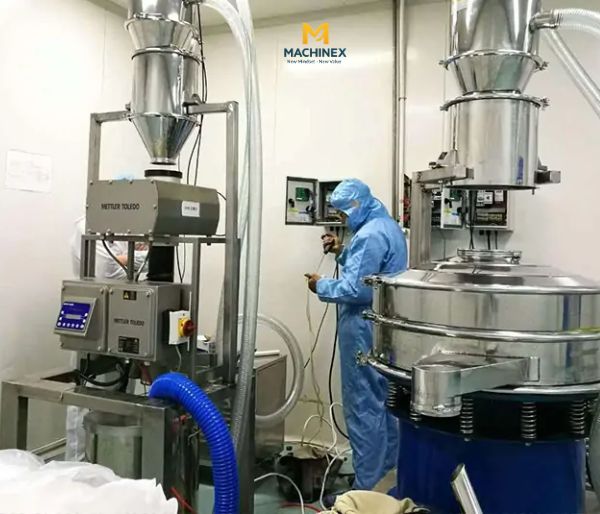
Technician checking and adjusting equipment in a production area (illustration, Machinex)
How do FAT, SAT and commissioning differ?
| Step | Where and when | Purpose | Who takes part |
|---|---|---|---|
| FAT | At the supplier's factory, before packing and shipping | Confirm equipment is built to design, works as specified and is safe | Supplier, buyer's representative, operating engineers |
| Installation and commissioning | On site, after installation and utility connection | Bring the system to stable running and tune parameters | Installation crew, control engineers, operators |
| SAT | On site, after commissioning | Confirm the system meets promised capacity and quality with real raw material | Buyer, supplier, quality unit |
Before FAT: documents to agree
- User requirement specification (URS): product, capacity, raw material, hygiene standard.
- Approved layout drawings, process flow diagram and P&ID.
- Equipment list, materials and stainless steel certificates (for example SUS 304, SUS 316L).
- FAT and SAT procedures and forms, with pass and fail criteria for each item.
- Inspection plan: dates, attendees, test material.
FAT checklist
| Item | What to check | Evidence |
|---|---|---|
| Visual and dimensional check | Against drawings: dimensions, connection positions, surface condition | Record, photos |
| Materials and welds | Stainless grade, thickness, ground-smooth welds, surface treatment, no dead legs | Material certificates, weld photos |
| Electrical and controls | Cabinet, I/O signals, PLC program, screens, alarms | I/O checklist, program copy |
| Safety | Emergency stop, interlocks, safety valves, protective devices | Function test record |
| No-load and loaded run | Run with water or substitute material; check leaks, noise, vibration | Record, video |
| Performance test | Capacity, cycle time, dosing accuracy, temperature, pressure | Measured data, charts |
| Packing and shipping | Equipment protection, marking, packing list | Packing list |
SAT checklist
| Item | What to check | Evidence |
|---|---|---|
| Installation conditions | Foundation, layout, power, water, steam and compressed air as required | Site handover record |
| Calibration | Temperature and pressure sensors, scales, flow meters | Calibration certificates |
| Run with real raw material | Produce real batches to the buyer's recipe | Batch record, product samples |
| Performance acceptance | Capacity, yield, product quality, energy consumption | Data, test results |
| Operator and maintenance training | Buyer's staff run the line and handle basic faults themselves | Training record |
| Handover documents | Operating manuals, as-built drawings, spare-parts list, certificates | Document set |
| Punch list | Remaining items, deadlines, responsible persons | Signed list |
Common acceptance mistakes
- No written criteria: invites disputes about what counts as a pass.
- Water-only test runs: real material behaves differently, so SAT should use real raw material.
- Missing documents: no material certificates, as-built drawings or manuals.
- Ignoring utilities: power, steam or cooling water not ready for the test.
- Insufficient training: staff cannot run the line alone once the supplier leaves.
Suggested approach in a turnkey project
- Agree acceptance criteria when signing the contract.
- Invite the buyer's representative to FAT and sign the record.
- Fix open points before shipping.
- Install, commission and run SAT with real raw material.
- Hand over documents, train staff and start the warranty period.
Related reading
- Cashew, jackfruit and mango processing lines for export
- GMP-oriented herbal extraction and concentration line
- Bottled water production line: treatment, RO and filling
- Strengths of Machinex Vietnam
Frequently asked questions
What is FAT?
FAT (Factory Acceptance Test) is acceptance testing of equipment at the supplier's factory, against agreed criteria, before shipment.
How is SAT different from FAT?
SAT (Site Acceptance Test) is done at the buyer's site after installation, usually with real raw material, to confirm capacity and quality.
Which documents should be ready before acceptance?
User requirements (URS), approved drawings and P&ID, the equipment list with material certificates, and acceptance forms with pass and fail criteria.
How long does acceptance take?
It depends on the size and complexity of the line; agree the plan and duration of each step in the contract.
Does Machinex carry out FAT and handover?
Yes. In a turnkey solution, Machinex Vietnam performs commissioning, FAT acceptance, training and handover to put the plant into use.
Need consulting, a site survey or a quotation? Contact us via Zalo / Viber / WhatsApp / WeChat: 0982786789 (+84 982 786 789)
Related news
- How to Choose an Industrial Essential Oil Distillation System: 10 Criteria and Comparison Tables
- Industrial Drying Technologies Compared: Hot Air, Heat Pump (Cold), Freeze, Vacuum Microwave and Spray Drying
- Fruit Juice Production Line: Process, Equipment List and How to Calculate Capacity
- GMP-Oriented Herbal Extraction and Concentration Line: Design, Equipment and Cost Factors