 Zalo

A bottled water line has four blocks: water treatment and storage, PET bottle preparation, rinse-fill-cap in a positive-pressure chamber, and labeling and packing. The main challenge is not just pure water but microbial control and preventing re-contamination. The treatment configuration must be based on laboratory results for your water source. When sizing capacity, include raw-water demand, because RO rejects part of the water.
Bottled water is a category with steady demand and lower entry barriers than many industries, but quality and brand reputation depend entirely on hygiene control. An industrial line must treat water to standard, fill under aseptic conditions and run reliably. This guide summarizes the water types, process, capacity calculation and questions to ask suppliers.
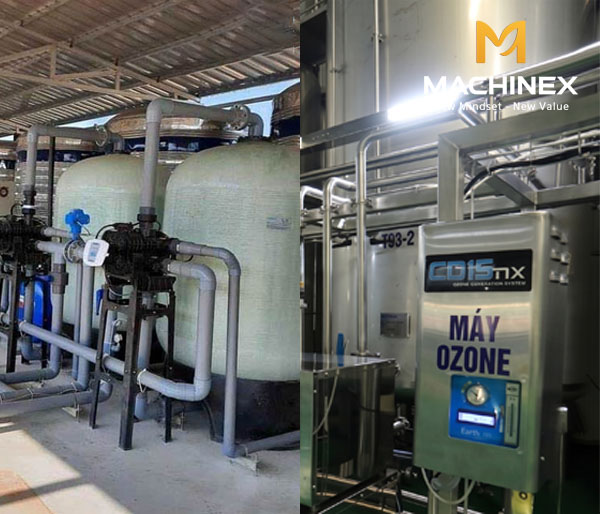
RO, UV and ozone water treatment system (Machinex)
Types of bottled water
| Type | Source and main treatment | Notes |
|---|---|---|
| Purified water | Tap or groundwater, multi-stage filtration, RO, disinfection | Very low minerals; microbial control is the focus |
| Natural mineral water | Recognized mineral source, mechanical filtration and disinfection, minerals retained | Needs source documentation and specific rules; RO is not always needed |
| Alkaline ionized water | Purified water, electrolysis, pH adjustment | Needs stable pH and mineral control |
| Bulk water (19 to 20 liter bottles) | Purified water, bottle washing, bulk filling | Washing and disinfection of reused bottles |
The 4 blocks of a PET bottle filling line
- Water treatment and storage: well or groundwater passes coarse filtration, heavy-metal and odor removal, RO (if needed), ozone or UV disinfection, then enters SUS 316L intermediate tanks.
- PET bottle preparation: blown bottles travel by air conveyor to the filling room, where they are sanitized and rinsed with clean ozonated water.
- Rinse - fill - cap: a 3-in-1 machine operates in a HEPA-filtered positive-pressure chamber that keeps outside air out.
- Labeling and packing: foreign-matter inspection, shrink-sleeve or adhesive labels, laser date coding and shrink-wrapping into packs of 6, 12 or 24 bottles.
Water treatment steps
There is no single filtration setup for every plant. Before design, test the source water fully for physical, chemical and microbiological parameters, especially total dissolved solids (TDS), hardness, iron, manganese and microbes.
| Step | Equipment | Role |
|---|---|---|
| Pre-treatment | Coarse filter, activated carbon, ion-exchange media | Remove sediment, organics, color and odor; soften water |
| Fine filtration | Micron cartridges (5 to 1 micron) | Hold back very fine particles before RO and filling |
| RO (reverse osmosis) | RO membranes and high-pressure pump | Strongly reduce dissolved minerals and impurities (purified water) |
| Disinfection | Ozone, UV or both | Kill microbes and help resist re-contamination |
| Storage | SUS 316L tanks, closed system | Stabilize quality before filling |
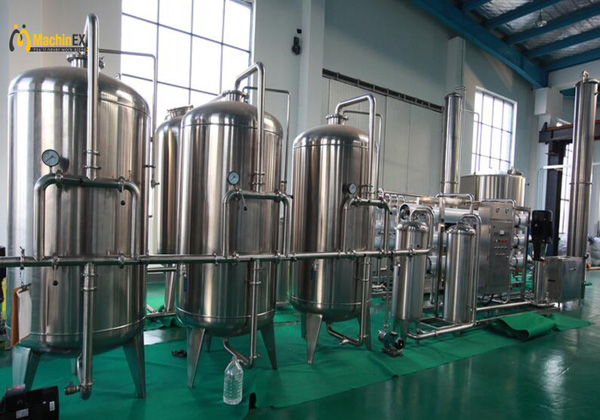
Water treatment tank bank in a bottled water plant (Machinex)
Ozone and UV compared
| Technology | Advantages | Notes |
|---|---|---|
| Ozone | Fast kill; disinfects bottles and water; leaves dissolved oxygen that helps resist re-contamination in tanks | Needs concentration control and ozone off-gas safety |
| UV | No added chemicals, easy to install | Only kills microbes at the point of exposure; water must be clear |
| Ozone plus UV | Two layers of protection, common in large plants | Higher investment and operating cost |
Calculating capacity and raw-water demand
Capacity is usually quoted in bottles per hour. Illustrative example: a line of 10,000 bottles of 500 ml per hour needs about 5,000 liters of finished water per hour. RO rejects part of the water (recovery is usually below 100%, depending on source and design). If recovery were 60%, raw water demand would be about 8,300 liters per hour. This is only an example; real figures depend on your water source and configuration.
- Check the source can supply a stable flow all year, including the dry season.
- Include bottle rinsing, system flushing and wastewater.
- Match filling capacity to treatment capacity to avoid bottlenecks.
- Leave headroom for expansion.
Points to watch when investing
- Standards: the water must meet the bottled-water technical regulation where it is made (in Vietnam, QCVN 6-1:2010/BYT) and product declaration requirements.
- Materials: tanks and piping that contact water in SUS 304 or 316L stainless steel with sanitary piping.
- Filling-area hygiene: HEPA-filtered positive-pressure chamber with controlled personnel access.
- Automation: monitoring of water quality, pressure, dosing and product counting.
- Service: trial run, acceptance (FAT), training, maintenance and replacement of filter cartridges and RO membranes.
Questions to send suppliers
- Which treatment configuration do you propose based on my water test results?
- RO recovery rate and raw water required?
- How are bottles, caps and the filling area disinfected?
- Filler speed and dosing accuracy?
- Tank and piping materials and hygiene standard?
- Cost and interval for replacing cartridges and RO membranes?
- Installation, trial run, training and warranty time?
Related reading
- Fruit juice production line: process and capacity
- Aseptic PET mineral and purified water bottling line
- Spirits, beer and soft drink equipment guide
- FAT and SAT checklist for plant acceptance
Frequently asked questions
Does mineral water have to go through RO?
Not always. RO strongly reduces minerals, so it suits purified water; mineral water that must keep its minerals usually uses mechanical filtration and disinfection, depending on source documentation and rules.
Why use a positive-pressure chamber for filling?
A HEPA-filtered positive-pressure chamber keeps outside air out, holding filling in aseptic conditions and preventing re-contamination.
How much raw water does a 10,000-bottles-per-hour line need?
In the illustrative example with 500 ml bottles and 60% RO recovery, about 8,300 liters per hour; real figures depend on your water source and design.
Does Machinex design bottled water lines to order?
Yes. Machinex Vietnam designs, fabricates, installs and commissions bottled water lines to your capacity and water source.
Need consulting, a site survey or a quotation? Contact us via Zalo / Viber / WhatsApp / WeChat: 0982786789 (+84 982 786 789)
Related news
- Turnkey Solutions for Food, Beverage, Post-Harvest Agriculture and Herbal Processing Plants
- How to Choose an Industrial Essential Oil Distillation System: 10 Criteria and Comparison Tables
- Industrial Drying Technologies Compared: Hot Air, Heat Pump (Cold), Freeze, Vacuum Microwave and Spray Drying
- Fruit Juice Production Line: Process, Equipment List and How to Calculate Capacity