 Zalo

There is no single best dryer. Choose by material form (solid pieces or liquid), the quality you must keep (color, aroma, crispness, nutrients), daily capacity and budget. Hot air is cheapest but can degrade quality; heat pump (cold) drying balances quality and cost; freeze drying gives the highest quality at the highest cost; vacuum microwave is very fast; spray drying turns liquids into powder.
Drying determines the value of many agricultural, herbal and food products: color, flavor, crispness, shelf life and rehydration. The wrong technology can strip nutrients, darken or shrink the product, or lead to over-investment. Machinex Vietnam builds several dryer lines: cold, heat pump, freeze, microwave, spray and vacuum dryers. This guide compares them so you can choose correctly.
Comparison of drying technologies
| Technology | Principle and temperature | Best for | Quality retention | Cost | Limits |
|---|---|---|---|---|---|
| Hot air drying | Hot air passes through the material at relatively high temperature | Ordinary produce, grains, heat-tolerant materials | Medium | Low investment | Color, aroma and heat-sensitive vitamins can be lost; shrinkage possible |
| Cold (heat pump) drying | Closed recirculating dry air dehumidifies at low temperature (Machinex line: 20 to 50 °C) | Fruit, herbs, premium food | Good | Medium; lower power than traditional drying (per Machinex product information, about 25 to 40%) | Longer drying time than hot air |
| Freeze drying (lyophilization) | Freezes the product then sublimes water under vacuum at very low temperature (chamber down to about −65 °C) | High-value products, pharmaceuticals, biologicals, crispy whole-piece fruit | Highest; moisture can fall below 1% | Highest (investment and power) | Long cycle (freezing stage typically 6 to 8 hours) |
| Vacuum microwave drying | Microwaves heat water from inside; vacuum lowers the evaporation temperature | High-value products needing fast drying, crisp and porous | Good to high | High | Needs even-heating control; specialist operation |
| Centrifugal spray drying | Atomizes a solution into hot air to form powder almost instantly (Machinex line: 5 to 1,000 L/h) | Liquids: instant coffee, herbal extracts, soluble powders | Good if temperature is controlled | Medium to high | Only for liquids or solutions |
| Low-temperature vacuum belt drying | Continuous belt inside a vacuum chamber | Viscous, clumping, heat-sensitive liquids unsuited to spray drying | Good | Medium to high | Specialized equipment |

Machinex industrial cold (heat pump) dryer
Choosing a dryer by product
| Product | Suggested technology | Reason |
|---|---|---|
| Soft dried fruit (jackfruit, mango, dragon fruit) | Heat pump (cold) drying | Keeps natural color and flavor at low temperature, reasonable cost |
| High-value crispy fruit | Freeze drying or vacuum microwave | Light crisp structure, good rehydration, nutrient retention |
| Herbal pieces and flowers | Cold or freeze drying | Preserves heat-sensitive actives |
| Extracts, instant coffee | Spray drying or vacuum belt drying | Turns liquid into powder |
| Grains, nuts, heat-tolerant produce | Hot air or conveyor microwave | High capacity, low cost |
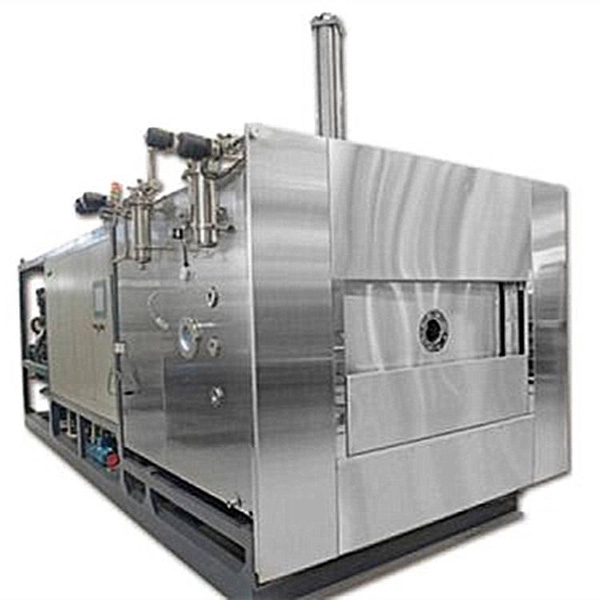
Machinex industrial freeze dryer (lyophilizer)
5 steps to choose a drying technology
- Define the material form: solid pieces, powder, grain or solution.
- Define the quality to keep: color, aroma, crispness, rehydration, actives.
- Calculate capacity: fresh material per day, inlet and target moisture.
- Compare total cost: investment, energy, labor, maintenance and payback.
- Run a sample trial: dry your real material and inspect the product before deciding.
Questions to ask suppliers
- Drying temperature and time for my material?
- Final moisture achieved and uniformity between trays?
- Energy use per kilogram of product?
- Construction material (304 stainless steel) and hygiene standard?
- Automatic control and batch data logging?
- Warranty, spare parts and technical support?
Related reading
- Cashew, jackfruit and mango processing lines for export
- Industrial jackfruit drying line for export
- GMP-oriented herbal extraction and concentration line
- Fruit juice production line: process and capacity
Frequently asked questions
How do cold drying and freeze drying differ?
Cold (heat pump) drying uses dry air at low temperature at moderate cost. Freeze drying freezes the material and removes water under vacuum, keeping the highest quality but at higher investment and energy.
What is spray drying used for?
For liquids or solutions that must become powder, such as instant coffee and herbal extracts.
How do I size a cold dryer?
Base it on fresh material per batch and batches per day. Machinex cold dryers come in many sizes, from about 20 to 300 kg per batch.
Does Machinex support sample trials?
Machinex advises on configuration and can propose trial runs with your material. Contact us via Zalo, Viber, WhatsApp or WeChat.
Need consulting, a site survey or a quotation? Contact us via Zalo / Viber / WhatsApp / WeChat: 0982786789 (+84 982 786 789)
Related news
- Bottled Water Production Line: Water Treatment, RO, Ozone/UV, Aseptic Filling and How to Size It
- FAT and SAT Checklist for Accepting a Food, Beverage or Herbal Processing Line
- Cashew, Jackfruit and Mango Processing and Drying Lines for Export: Process, Equipment and Quality Requirements
- Spirits, Beer and Soft Drink Equipment: How to Choose Distillation Columns, Aging Machines, Toxin Filters and Filling Lines