 Zalo

An industrial fruit juice line includes receiving and sorting, washing, preparation and pressing or pulping, filtering, blending, homogenizing, pasteurizing, filling, capping, labeling and packing. When choosing, calculate capacity in tons of fruit per hour using each fruit's juice yield, then pick the pasteurizing and filling option that fits your shelf-life and distribution channel. Machinex Vietnam offers a 3-ton-per-hour industrial orange juice line and multi-fruit lines.
Fruit juice is a beverage category with steadily rising demand as consumers care about health and natural products. An industrial line must preserve the fruit's flavor and vitamins, meet food hygiene and safety requirements and run reliably through the season. This guide explains the process, main equipment and capacity calculation to support an investment decision.
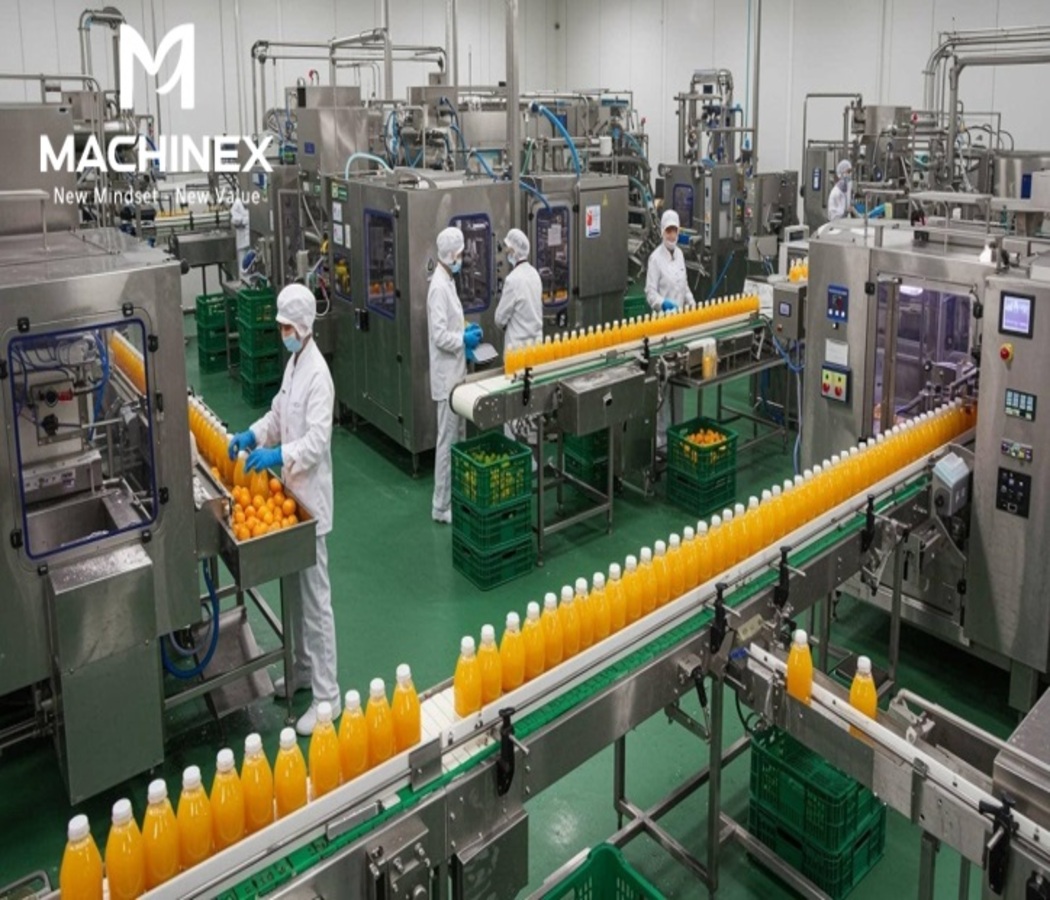
Industrial fruit juice processing line (Machinex)
Process and main equipment
| Stage | Main equipment | Purpose |
|---|---|---|
| 1. Receiving and sorting | Conveyors, sorting table, size grader | Remove bruised or bad fruit; standardize input |
| 2. Washing | Air-bubble washer, spray washer | Remove soil, dust and surface residue |
| 3. Preparation | Peeler, destoner, crusher (depending on fruit) | Prepare the fruit for pressing |
| 4. Pressing or pulping | Screw press, citrus extractor, pulper | Obtain juice or puree |
| 5. Filtering | Filter, centrifuge or fine finisher | Remove pulp, seeds and sediment |
| 6. Blending | Blending tank with agitator | Adjust Brix, acidity and flavor to the recipe |
| 7. Homogenizing | High-pressure homogenizer | Make uniform and limit separation |
| 8. Pasteurizing | Tubular or plate pasteurizer | Kill microorganisms and extend shelf life |
| 9. Filling and capping | Automatic filler, capper | Fill bottles or cans to volume |
| 10. Labeling and packing | Labeler, date coder, shrink wrapper | Finish the product |
Pasteurizing and filling options compared
| Option | How it works | Advantages | Notes |
|---|---|---|---|
| Hot fill | Pasteurize then fill hot into heat-resistant bottles | Moderate investment, widespread | Needs heat-resistant packaging; heat affects flavor |
| Tunnel pasteurization after filling | Capped bottles pass through a heating tunnel | Suits many package types | Takes floor space; uses energy |
| Aseptic filling | Flash-pasteurize then fill into sterilized packaging | Keeps flavor well, long shelf life | Higher investment and operating demands |
How to calculate capacity
Line capacity is usually quoted in tons of fruit per hour. You need each fruit's juice yield (it varies with variety, ripeness and pressing technology) and the bottle size. Illustrative example only: a 3-ton-per-hour line, assuming about 45% juice recovery, yields about 1,350 liters per hour, equal to about 2,700 bottles of 500 ml per hour. Real figures depend on the fruit, season and losses at each stage, so run a trial with your own material.
- Define the season and the fruit volume you can supply reliably.
- Decide on one fruit or several, to choose a multi-fruit line.
- Match filling capacity to pressing capacity to avoid bottlenecks.
- Reserve capacity for future expansion.
Points to watch when investing
- Materials: juice-contact parts in SUS 304 stainless steel or better, with sanitary piping that is easy to clean (CIP).
- Automation: PLC control stabilizes pasteurizing and dosing.
- Hygiene and safety: design to GMP and HACCP requirements for your target market.
- Flexibility: one line can press several fruits, and with suitable added stages even make fermented drinks and syrup.
- Trial and FAT: accept the line with real raw material before handover.
Related reading
- Industrial drying technologies compared
- Bottled water production line: treatment, RO and filling
- CO₂ recovery system for carbonated beverage lines
- FAT and SAT checklist for plant acceptance
Frequently asked questions
How much juice does a 3-ton-per-hour line produce?
It depends on the fruit and pressing yield. In the illustrative example at about 45% yield, about 1,350 liters per hour; real figures need a trial with your fruit.
Should I choose hot fill or aseptic filling?
Hot fill has moderate investment and is widespread but needs heat-resistant packaging. Aseptic filling keeps flavor better with longer shelf life at higher investment.
Can one line press several fruits?
Yes. A multi-fruit line handles several fruits, though each may need different preparation and pressing equipment.
Does Machinex design juice lines to order?
Yes. Machinex Vietnam designs, fabricates, installs and commissions juice lines to your capacity and raw material.
Need consulting, a site survey or a quotation? Contact us via Zalo / Viber / WhatsApp / WeChat: 0982786789 (+84 982 786 789)
Related news
- How to Choose an Industrial Essential Oil Distillation System: 10 Criteria and Comparison Tables
- Industrial Drying Technologies Compared: Hot Air, Heat Pump (Cold), Freeze, Vacuum Microwave and Spray Drying
- GMP-Oriented Herbal Extraction and Concentration Line: Design, Equipment and Cost Factors
- Bottled Water Production Line: Water Treatment, RO, Ozone/UV, Aseptic Filling and How to Size It