 Zalo

To choose the right industrial essential oil distillation system, work through these points in order: raw material and volume, distillation method, still capacity, heat source, materials (SUS 304 or 316L stainless steel), condenser, oil-water separator, level of automation, safety and after-sales service. This guide gives 10 criteria, two comparison tables and a list of questions to send suppliers before you invest.
An industrial essential oil system is a major investment, and a wrong configuration costs even more: lost oil, uneven quality between batches, high fuel and labor use. These 10 criteria help investors compare options systematically. Machinex Vietnam supplies industrial essential oil distillation systems from 500 to 25,000 liters and has delivered many projects in Vietnam.

Industrial essential oil distillation system (Machinex)
1. Start with raw material and volume
Each material (leaves, stems, flowers, peel, roots, seeds) differs in bulk density, oil content and handling. Define the main and secondary raw materials, daily volume, seasonality (concentrated harvest or year-round) and the number of batches per day. A plant running one seasonal crop chooses differently from a facility distilling many materials all year.
2. Choose the distillation method
The method affects aroma quality and yield. This table compares the three common approaches:
| Method | How it works | Best for | Notes |
|---|---|---|---|
| Steam distillation (boiler steam) | Saturated steam passes through the material bed | Industrial scale; lemongrass, tea tree, mint, citrus | Needs a boiler; good pressure control, little scorching |
| Water-and-steam distillation | Material rests on a grid, water is heated below | Medium scale, many materials | No separate boiler; less control |
| Hydrodistillation (immersed) | Material sits directly in boiling water | Powdery or clumping materials | Scorching risk; longer cycle |
For premium oils some businesses also consider supercritical CO₂ extraction, which costs far more and suits high-value products.
3. Choose the still capacity
Still volume should match the raw material per batch and the boiler capacity. A still too large for your supply runs underloaded; too small means more batches and more labor. Ask the supplier to calculate from your real bulk density and batch time, not just quote liters.
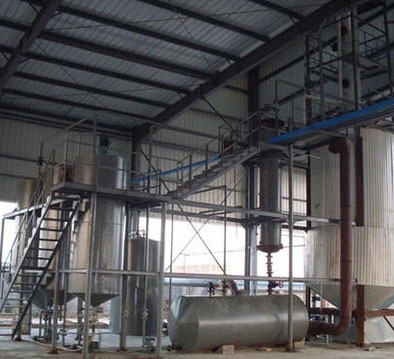
Essential oil distillation project in Ca Mau (Machinex)
4. Choose the heat source
| Heat source | Advantages | Limits |
|---|---|---|
| Boiler (gas, wood, electric) | Stable steam, good pressure control, suits large scale | Boiler and piping investment; boiler operator needed |
| Electric heating | Clean, easy to control, small to medium scale | High power cost for continuous large capacity |
| Gas | Flexible, quick to install | Gas safety control; price fluctuation |
| Wood or biomass | Low fuel cost in raw-material regions | Harder temperature control; smoke and environmental rules |
5. Construction materials
Parts that contact material and oil should be food-grade stainless steel. SUS 304 is the common choice; SUS 316L resists more corrosive materials better. Ask about steel thickness, weld quality and surface finish, which are easy places to cut cost.
6. Condenser and cooling
The condenser determines how much volatile compound you recover. You need enough heat-exchange area for the vapor flow, a stable cooling-water supply (recirculated through a cooling tower or chiller) and materials that withstand the mixed vapor stream.
7. Oil-water separator and hydrosol recovery
After condensing, essential oil and aromatic water (hydrosol) are separated in an oil-water separator. Its design depends on whether the oil is lighter or heavier than water. If you want to sell or reuse hydrosol, plan separate tanks and a recovery routine.
8. Level of automation
Temperature and pressure sensors, automatic valves and a PLC cabinet repeat the right program for each material and reduce dependence on individual operators. Higher automation raises upfront cost but cuts labor and batch-to-batch variation.
9. Safety, hygiene and standards
A still works with pressurized steam (typically 2 to 4 bar), so it needs safety valves, pressure gauges and pressure equipment that meets the inspection rules where it is installed. For export markets choose easy-to-clean designs (sanitary piping, clamp connections, CIP support) and full technical documentation.
10. After-sales service and commissioning
Ask for a trial run with your own raw material, an acceptance record, operator training and a commitment on maintenance and spare parts. On large projects agree the equipment acceptance criteria (FAT) up front.
Questions to send suppliers
- What still capacity and raw material per batch for my crop?
- Cycle time and required boiler capacity?
- Material, thickness and weld standard?
- Operating temperature, pressure and safety devices?
- Condenser area and cooling-water demand?
- Level of automation, and are batch records kept?
- Lead time, installation, training and warranty?
Related reading
- Automatic industrial-scale essential oil production line
- GMP-oriented herbal extraction and concentration line
- Industrial drying technologies compared
- FAT and SAT checklist for plant acceptance
Frequently asked questions
What still capacity should I choose?
It depends on raw material per batch and batches per day. Give the supplier your material, daily volume and season so they can size the still, boiler and number of stills.
SUS 304 or 316L stainless steel for an essential oil still?
SUS 304 is enough for most materials and is the common choice. Consider 316L when the material or water is highly corrosive.
Is boiler steam better than direct heating?
At industrial scale boiler steam is usually easier to control for pressure and scorches material less, but it needs a boiler investment and proper operation.
Can Machinex advise on and design a distillation system?
Yes. Machinex Vietnam designs, fabricates, installs and commissions industrial essential oil distillation systems from 500 to 25,000 liters.
Need consulting, a site survey or a quotation? Contact us via Zalo / Viber / WhatsApp / WeChat: 0982786789 (+84 982 786 789)
Related news
- Industrial Drying Technologies Compared: Hot Air, Heat Pump (Cold), Freeze, Vacuum Microwave and Spray Drying
- Fruit Juice Production Line: Process, Equipment List and How to Calculate Capacity
- GMP-Oriented Herbal Extraction and Concentration Line: Design, Equipment and Cost Factors
- Bottled Water Production Line: Water Treatment, RO, Ozone/UV, Aseptic Filling and How to Size It